
The allure of global talent is simple: access exceptional professionals at competitive rates. The trap is equally simple: without rigorous vetting, "affordable" quickly becomes "expensive" when you factor in the cost of bad hires. CareerBuilder research estimates that 75% of employers have hired the wrong person for a position, and each bad hire costs an average of $17,000 in direct expenses — but the figure climbs to $240,000+ when you include lost productivity, team disruption, and management time consumed by performance issues.
When hiring across borders, the vetting challenge intensifies. You can't rely on local reputation signals, alumni networks, or in-person rapport assessment. Credentials from unfamiliar institutions are difficult to evaluate. Cultural communication differences can mask — or inflate — actual competency. This is precisely why most companies that attempt DIY international hiring without expert screening end up with disappointing results and retreat to expensive domestic-only models.
Rekrutify exists to solve this problem systematically. Our leadership team has spent years building a vetting infrastructure that consistently identifies elite talent from booming offshore IT ecosystems — professionals who perform at the same level as their US counterparts at a fraction of the cost. Here's exactly how we do it.
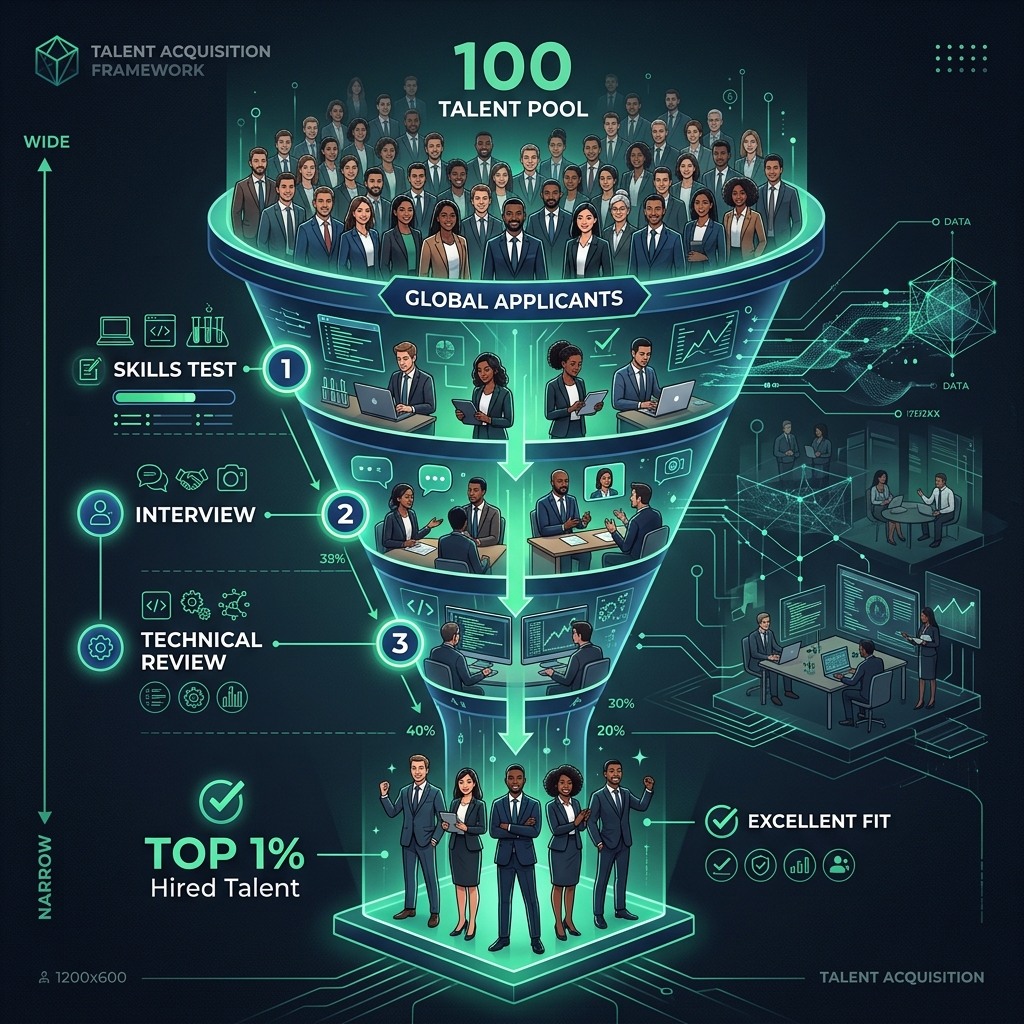
Rekrutify's vetting process is a 5-stage pipeline designed to evaluate every dimension of professional capability. Each stage is eliminative — candidates must pass each stage to advance to the next. The cumulative pass rate is approximately 3%, meaning only the exceptional make it through. Here's what each stage evaluates and why it matters.
Every candidate begins with a comprehensive skills assessment tailored to their discipline. For software developers, this includes algorithmic problem-solving challenges, system design questions, and framework-specific coding tests. For medical billers, we test ICD-10/CPT coding accuracy, payer-specific submission knowledge, and EHR software proficiency. For digital marketers, we evaluate SEO audit capabilities, PPC campaign structuring, and analytics interpretation.
This isn't a generic aptitude test — it's a discipline-specific evaluation designed by domain experts who understand what "excellent" looks like in each role. Approximately 40% of candidates are eliminated at this stage because their technical skills, while adequate, don't meet our threshold for excellence.
Technical skill without clear communication is useless in a distributed team. Our English assessment goes far beyond written grammar tests. Candidates participate in live conversation evaluation conducted by native English speakers who simulate real workplace scenarios: explaining a technical decision to a non-technical stakeholder, responding to a frustrated customer escalation, participating in a mock sprint planning session.
We evaluate pronunciation clarity, vocabulary range, listening comprehension, and the ability to communicate nuanced ideas concisely. Our professionals generally excel here — thanks to English-medium education systems — but we maintain rigorous standards that eliminate candidates who might struggle with real-time client communication.
Technical competence and English fluency aren't enough. We need professionals who demonstrate initiative, accountability, and cultural compatibility with US business norms. Our behavioral interviews use structured scenarios to assess: How do they handle ambiguity? What happens when they receive critical feedback? How do they prioritize competing deadlines? Do they proactively communicate blockers or wait to be asked?
We specifically evaluate traits that predict success in distributed environments: self-direction (can they work independently without constant supervision?), communication discipline (do they over-communicate status updates rather than disappearing?), and professional resilience (how do they respond when a client changes requirements mid-sprint?).
Candidates who survive the first three stages face a hands-on project that simulates actual client work. This isn't a toy problem — it's a meaningful task that takes 4–8 hours to complete and reflects the complexity and quality standards of real engagements. Developers build a functional feature. Content marketers produce a publication-ready article. Medical billers process a batch of complex claims.
The evaluation criteria mirror what clients care about: code quality, attention to detail, adherence to specifications, creative problem-solving, and delivery within the agreed timeline. This stage eliminates candidates who interview well but underperform in execution — the most expensive type of bad hire to discover after placement.
The final validation happens in the real world. Every Rekrutify placement includes a free 1-week trial period where the client works directly with the professional. This isn't a formality — approximately 6% of candidates who pass all four internal stages don't convert to full engagements because the specific client chemistry isn't right. And that's okay. We replace them immediately at zero cost until we find the perfect fit.
Learn more about Rekrutify and our quality-first philosophy. Explore our transparent pricing model that ensures you only pay for validated, proven talent. Start your free trial today and experience what it feels like to work with the top 3% — without the headache of finding them yourself. Review our client case studies to see the measurable impact of elite talent on real business outcomes.
One simple hourly rate. Zero recruitment hassle. A team that feels like your own. Rekrutify — Talent Without Borders.